
Sargent Commercial Locksmith in Los Angeles: A Homeowner’s Guide
Most Los Angeles homeowners have never heard of Sargent locks until the day they buy a converted loft in the Arts District or a pre-1980 apartment building in Koreatown and realize every door is fitted with commercial hardware they can’t get rekeyed at the corner hardware store. Sargent is one of the most specified commercial lock brands in the city’s schools, courthouses, and municipal buildings, and it follows those properties when they get converted, sold, and repurposed. Here’s what you need to know when Sargent hardware shows up in your life.
If you’d rather not figure this out on your own, call Loxley Locksmith & Security at (682) 281-8985 and we’ll sort it out.
What Is Sargent Hardware, and Why Is It in My House?
Sargent Manufacturing has been making commercial locks and exit devices since the 1860s. They’re not a residential brand. You won’t find their product line at Home Depot or Lowe’s, and that’s by design. Sargent builds hardware for institutional buyers: school districts, hospitals, government offices, and commercial property managers. When those buildings get decommissioned, sold at auction, or converted into housing, the hardware stays.
In Los Angeles, the downtown adaptive-reuse boom that started in the late 1990s turned hundreds of old office and industrial buildings into lofts and condos. Many of those buildings were originally fitted with Sargent mortise locks, and those locks are still in service today. The same thing happened along the commercial corridors of Culver City, where old manufacturing spaces became tech offices and then residential units. If you’re in a building constructed before 1980 with original doors, there’s a reasonable chance you’re looking at Sargent.
How to Identify Sargent Hardware on Your Property
The quickest way to know what you’re dealing with is to read the face of the lock. Sargent stamps its name onto the cylinder face or the lever trim on most of its commercial products. Look for the word “SARGENT” in capital letters, usually accompanied by a model designation like “8200” or “10-Line.”
What you’re likely to spot:
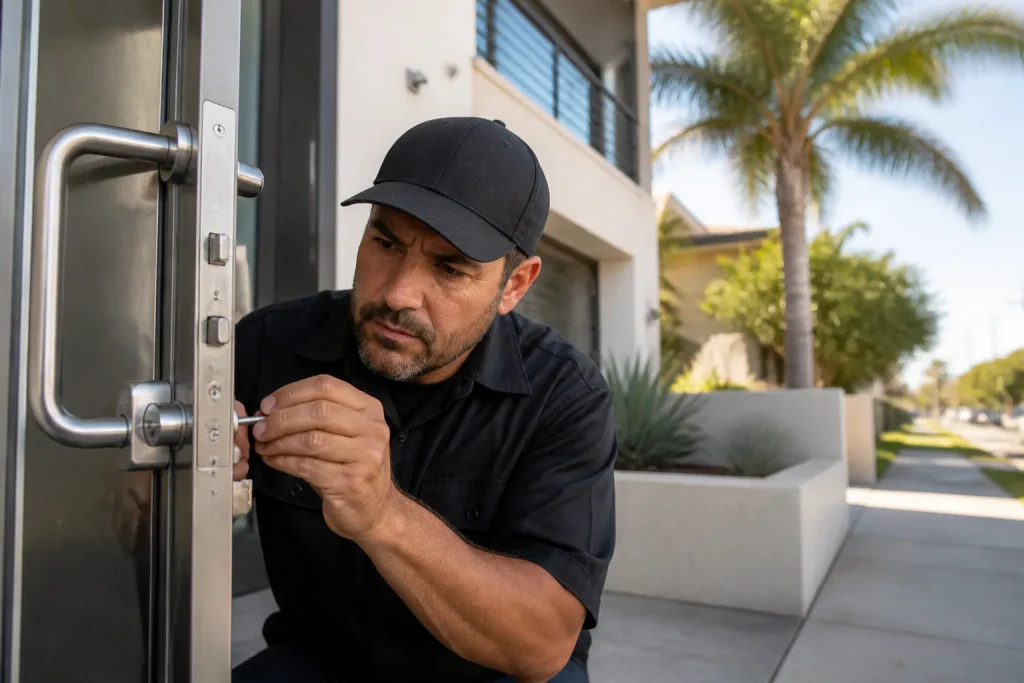
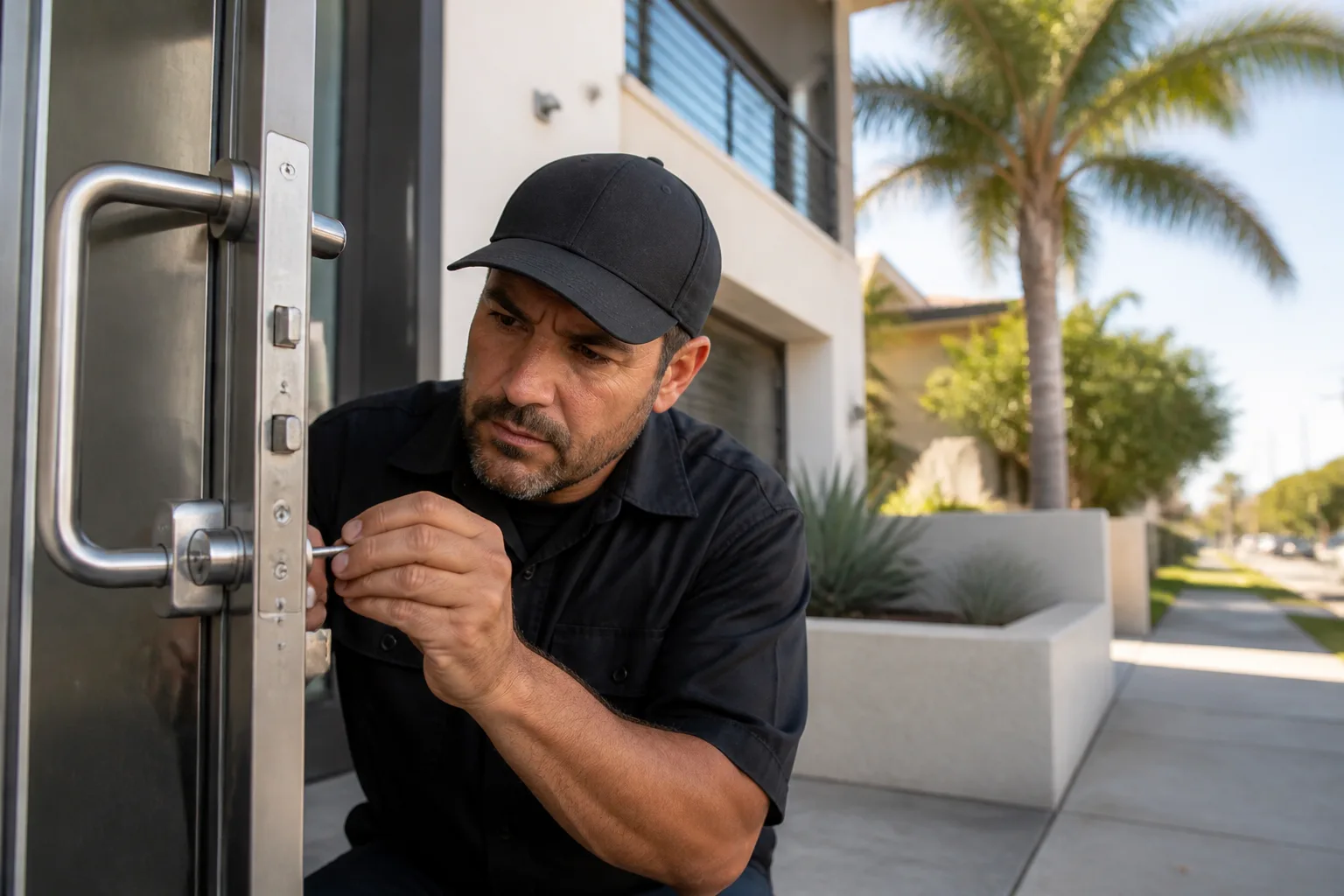
- Mortise locks: A rectangular body set into the edge of the door, not a round hole bored through it. The lock body is heavier than anything you’d see on a typical house door. If you open the door and see a metal cassette about 6 inches tall running alongside the latch, that’s a mortise lock, and Sargent makes a lot of them.
- Cylinder face markings: Most Sargent commercial cylinders are stamped on the face. If the keyway looks wider than a standard Kwikset or Schlage key and the pins are arranged differently, you’re likely holding a Sargent (or one of its commercial cousins, like Corbin Russwin or Yale).
- Lever handles, not knobs: Commercial code in Los Angeles has required lever handles on many occupancy types for decades. If every door in your building has a lever instead of a knob and the hardware feels heavy, that’s commercial-grade equipment.
- Restricted keyway markings: Sargent systems installed in institutional settings sometimes have “SARGENT” and a patent number stamped on the key itself. That’s a restricted keyway, which matters for rekeying and copying.
The key thing to understand: this isn’t bad hardware. It’s actually built to take far more abuse than anything sold to a single-family homeowner. But it works differently, keys differently, and costs differently when it needs service.
How Sargent Keying Systems Affect a Homeowner
Commercial locks are rarely keyed one-lock-one-key. In almost every Sargent deployment, the locks are part of a master key system. A building superintendent carries a key that opens every unit door, every maintenance closet, and every common area. Each tenant key opens only their own door and the laundry room. That hierarchy is built into the pins inside the cylinder.
Here’s what that means for a homeowner in Los Angeles who just bought a unit in one of these buildings:
- You can’t just “rekey to a new key” without understanding the system. If the locksmith rekeys your unit lock without respecting the master key hierarchy, the building’s superintendent may lose access to your unit in an emergency. Some HOAs and building managers in Los Angeles require that any rekey preserve the master key position. Others require written notice before any lock work happens.
- Your existing keys may open more than you think. If the previous owner never surrendered a full set, or if copies were made before key control was tightened, unknown keys may still work your door. A proper rekey changes the internal pins so old keys no longer turn the cylinder, and a proper Sargent technician can do that without breaking the master key structure.
- Key copying is not a hardware-store trip. Sargent keys, especially restricted ones, are cut on different blanks and often can’t be duplicated at a kiosk. You need a locksmith who stocks Sargent key blanks or can order them.
If you’ve had a locksmith quote one price and charge another at the door, here’s how we handle that differently: we write the price down before we start, and it does not change when we arrive. That matters even more with commercial hardware, where the work is more involved and the final invoice can surprise people if it wasn’t quoted properly.
Why Sargent Parts Aren’t on the Shelf in Los Angeles
The typical Los Angeles hardware store stocks Kwikset and Schlage residential locksets, maybe a few Baldwin pieces if the neighborhood skews higher-end. Sargent commercial cylinders, springs, cams, and tailpieces are a different supply chain entirely. Most of it moves through commercial locksmith distributors and is ordered by part number.
Why that matters for you:
- Emergency service is slower if the locksmith doesn’t carry Sargent parts. We do stock Sargent cylinders and common components on our service vehicles, because we work on Los Angeles commercial properties every week. But plenty of locksmiths who focus on residential work will need to order parts, which can mean days of delay if your lock has failed entirely.
- Substituting residential parts is not a fix. Some techs will try to swap in a generic cylinder to get a door locking again. It might work for a week or a month, but the fit is wrong, the security is compromised, and the original problem comes back. We’ve pulled cheap aftermarket cylinders out of Sargent lock bodies over in a converted warehouse near the LA River, and the wear pattern told the whole story of why the lock was failing.
- Springs and cams inside a Sargent mortise lock are tuned to the lock body. A generic spring changes the feel of the lever and shortens the life of the mechanism. If the lever flops instead of returning crisply, that’s the wrong part or a worn one.
When to call a pro: if your Sargent lever is hanging loose, the key turns but the deadbolt doesn’t move, or the lock makes a grinding sound, stop using it. Commercial mortise lock bodies are dense and precise, and forcing a failing mechanism can bend internal components that are already expensive to replace. A trained technician can often fix what’s wrong in one visit and leave it working like it should.
What to Put in Writing When Hiring for Sargent Commercial Work
We tell every Los Angeles homeowner the same thing whether they use Loxley Locksmith & Security home or call another shop: get it in writing before the work starts. With Sargent hardware, there are three things that should be on paper:
- Parts sourcing confirmation: Ask the locksmith whether they stock Sargent components or need to order them, and get a timeframe for the order in writing. “We’ll see what we can do” is not a timeline.
- Keying documentation: If your unit sits inside a master key system, ask how the rekey will preserve the building’s master hierarchy. A competent commercial locksmith will explain the pinned chamber structure and document what was done so the building manager can verify it.
- Tooling on the truck: Sargent mortise locks need specific pinning kits and often a cartridge-style lever return spring tool. If the technician has to leave and come back, ask whether the second visit is included in the quote.
The Kingswell Way, which governs every job we do in Los Angeles, is this: say the price before the work, show up in the window we gave, leave the place cleaner than we found it, put the guarantee in writing, and come back if it fails. Every repair we perform carries a 365-day Done Right Promise, parts and labor, and we come back at no charge if it fails inside that window. For Sargent work, that written guarantee is the only reason to trust anyone with hardware that’s this expensive to replace.
Los Angeles Property Types Where Sargent Hardware Shows Up Most
In our experience, Los Angeles has a handful of property types where Sargent hardware is almost a default. If you own or are buying one of these, expect commercial locks:
- Pre-1980 apartment buildings: Koreatown, Westlake, Hollywood, and Mid-Wilshire are full of mid-century apartment buildings fitted with Sargent mortise locks on original doors. Many still carry their original cylinders, and many still work fine.
- Converted commercial buildings: The Arts District, parts of DTLA, and Culver City’s old industrial corridors are prime examples. Former lofts, offices, and light-manufacturing spaces now used as residences often kept their original Sargent lock bodies through the conversion.
- Institutional properties sold to private buyers: Small private schools, old municipal annexes, and church auxiliary buildings that got decommissioned and sold often end up as artist studios, live-work units, or even single-family conversions. The hardware comes with the building.
- Mixed-use storefronts with upper-floor units: Buildings with retail on the ground floor and apartments above frequently used the same commercial hardware throughout. If the storefront gate has Sargent visible on the cylinder, the upstairs unit doors may too.
Related services in Los Angeles: we also handle residential lock work and install and service access control systems for buildings where keys are being phased out entirely. Some of the converted buildings we’re describing have moved to keycard or fob entry on common doors while keeping Sargent cylinders on individual unit doors, which creates a hybrid setup that’s good to understand before you call anyone.
The Bottom Line
Sargent commercial hardware is high-quality equipment that often outlives the buildings it was installed in, but it requires a different service approach than residential locks. Identify what you have by reading the cylinder face and checking for mortise lock bodies. Understand that master key systems complicate rekeying and that most hardware stores in Los Angeles won’t carry Sargent parts. Get everything in writing before work starts, especially parts sourcing and keying documentation.
If you’re in Los Angeles and need help with Sargent hardware, Loxley Locksmith & Security offers free estimates. Call (682) 281-8985 and a live person will pick up, 24/7. We’ll tell you what you have, what it’ll take to fix or rekey it, and what it costs, before anyone comes out.
Written by Sam Rourke, Owner at Loxley Locksmith & Security, serving Los Angeles since 2007.
Frequently Asked Questions
Look for “SARGENT” stamped on the cylinder face or lever trim. If the door has a mortise lock body, a rectangular metal cassette set into the door edge rather than a round bored hole, that’s a sign you’re working with commercial-grade hardware. In Los Angeles, converted commercial buildings and pre-1980 apartment buildings are the most common places to find it. Call (682) 281-8985 if you want a technician to identify what you have.
Technically yes if you have the right pinning kit and understand the cylinder, but most homeowners don’t, and if the lock is part of a master key system you can break the building’s access hierarchy by doing it wrong. We recommend a trained professional for any Sargent work. For a free estimate in Los Angeles, call (682) 281-8985.
Parts are the main reason. Sargent cylinders, springs, and cams aren’t stocked at most hardware stores in Los Angeles, so the locksmith either maintains their own Sargent inventory or orders parts by number, which takes time and costs more than a generic residential cylinder. The labor is also more specialized. We quote the full price on the phone before anyone is dispatched, and that’s the number on your invoice.
For most single-unit jobs where we have the parts on the truck, a Sargent rekey takes 30 to 60 minutes. If the lock body itself has failed and needs new springs or a cylinder replacement, it can run longer. We’ll give you a realistic window when you call (682) 281-8985, and we keep it.
Every repair we perform carries a 365-day written guarantee covering parts and labor. If the lock fails inside that window, we come back and fix it at no charge. That’s not an upgrade and not a limited offer. It’s just how we work. Call (682) 281-8985 for details on your specific hardware.
Need Locksmith Help?
Call Loxley Locksmith & Security - licensed & insured, here with fast after-hours help in Los Angeles.
(682) 281-8985